§ Brand — Specimen · hinomiya
HINOMIYA
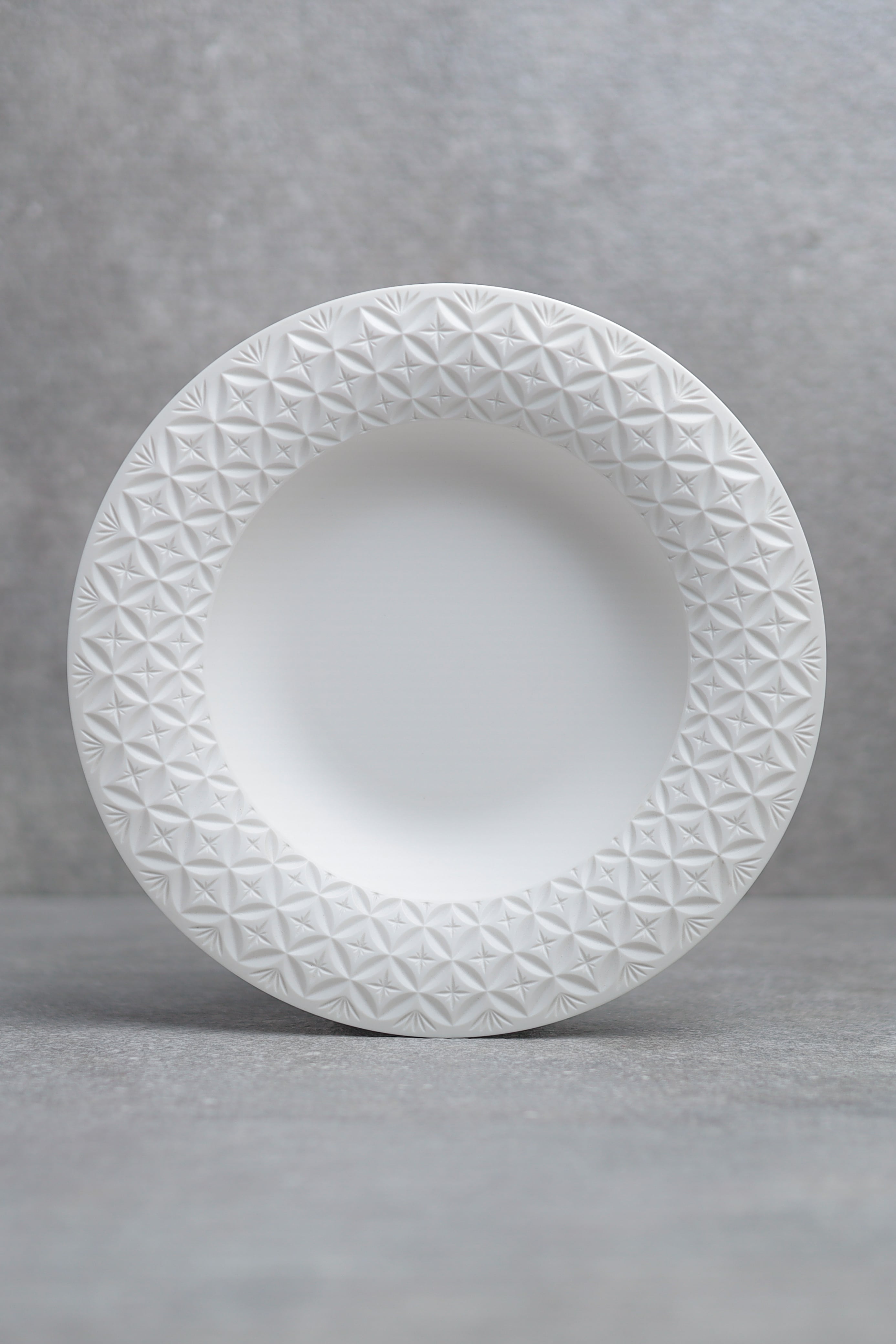
A new lineage of Mino ware — porcelain that lets light through its kiriko relief.
ヤマカ陶料 × 黒田製型所 × 鋳込み師 水野 × 美萩工芸 × 宮下将太 × 東金聖
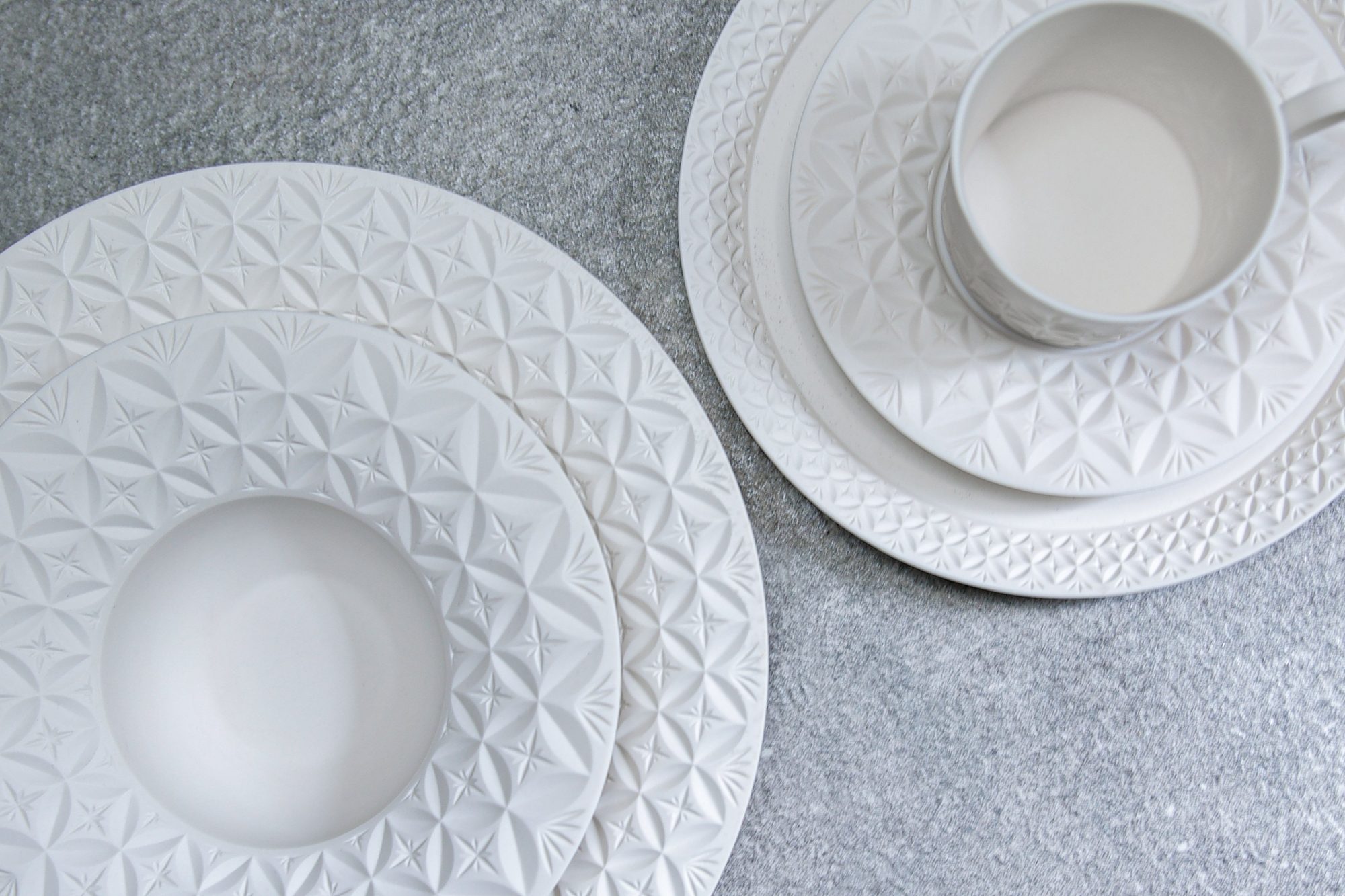
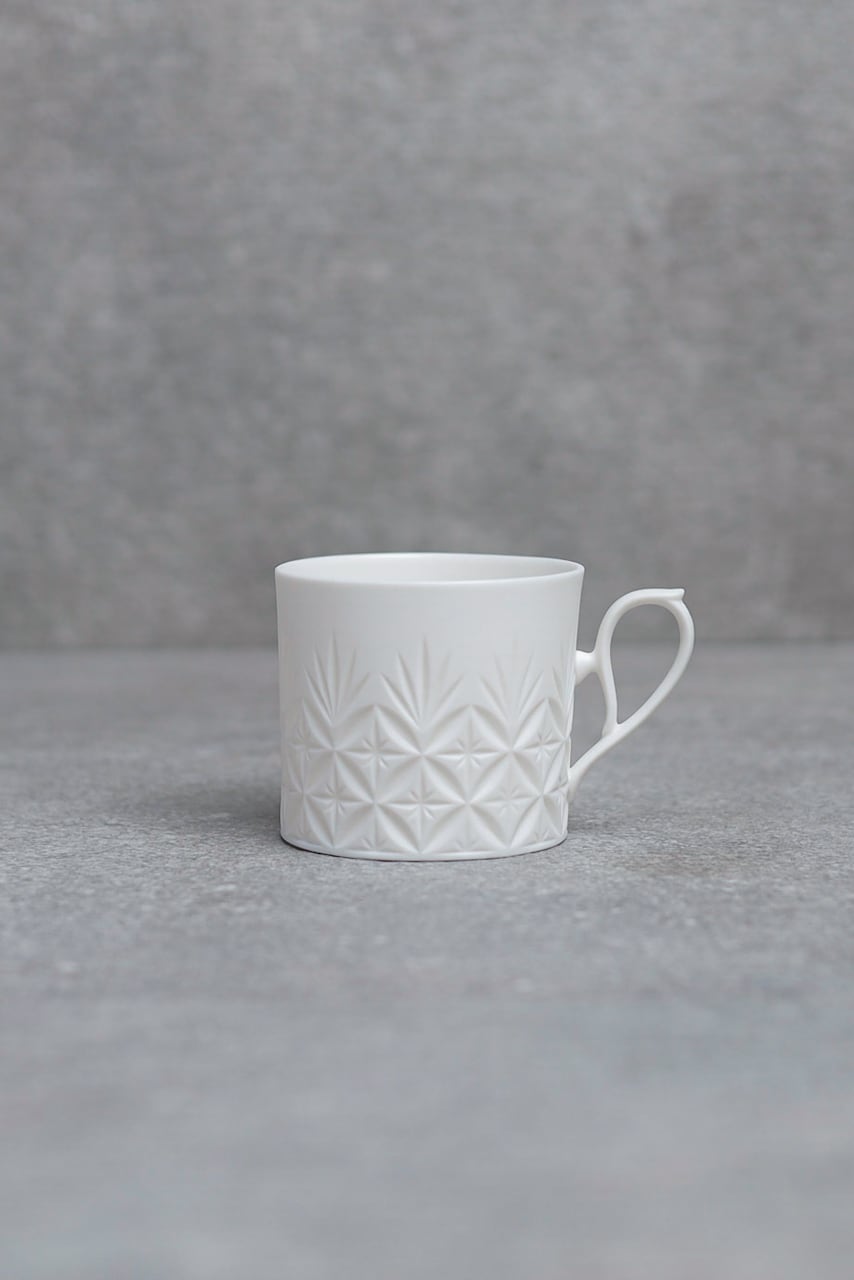
Fig. I — HINOMIYA kiriko / 光に透ける七宝繋ぎ
§ I — Concept · Ph-01
Brand philosophy.
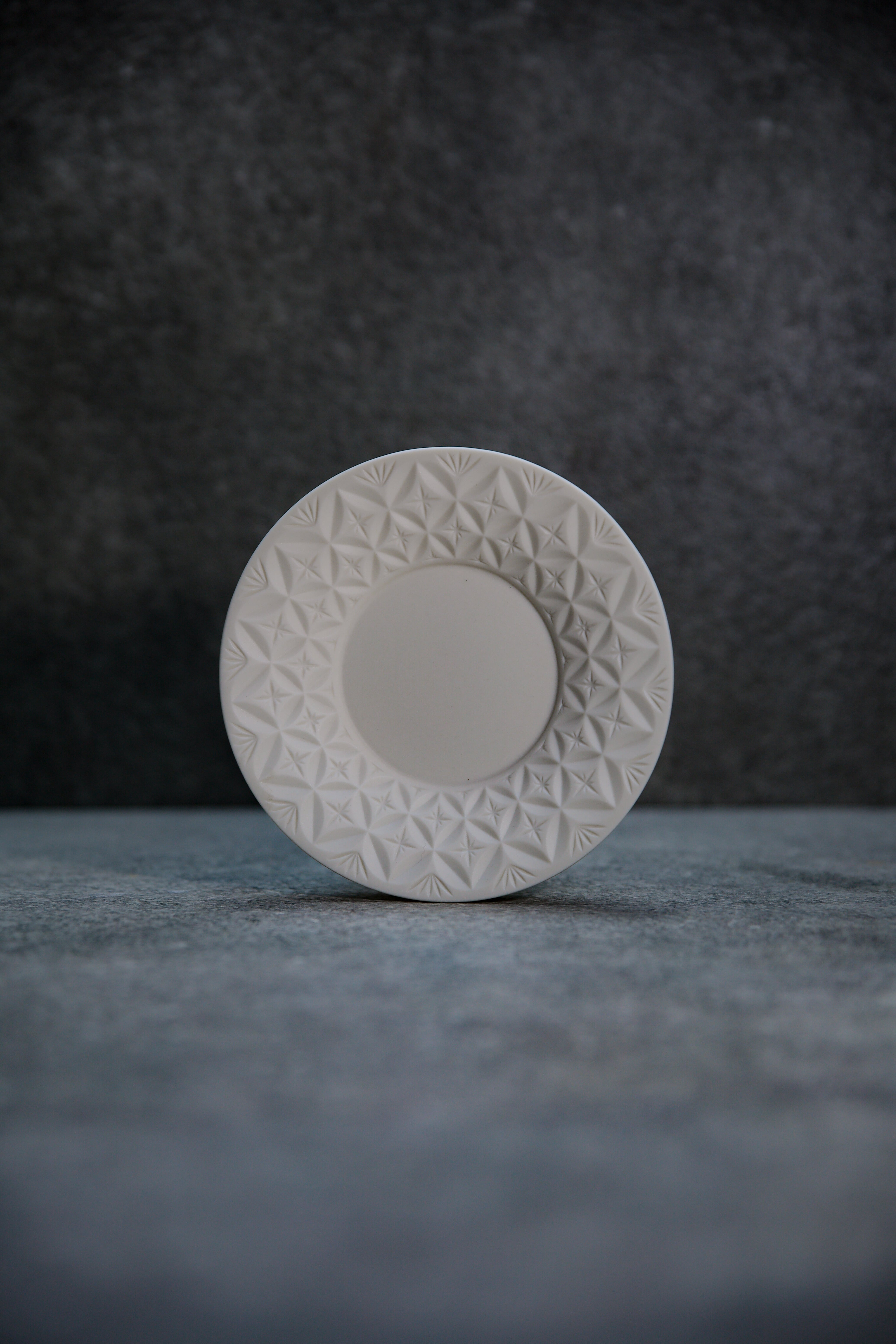
HINOMIYA is a new form of Mino-yaki — a fusion of the region's traditional mass-production craft and the imagination of contemporary ceramicists. Directed by ceramicist Shota Miyashita, the kiriko-inspired pattern was designed in 3DCAD by artist Hijiri Tougane and is realized on pure porcelain bodies.
Mino is the largest ceramic-producing region in Japan, and the one that has nurtured the most Living National Treasures. In Toki, the Oribe Hills district (Toki Mino-yaki Wholesale Center) gathers the long-established wholesalers, potteries, mold-makers, and packagers who carried Mino through the postwar era — the same cultural ground on which one of Japan's three great pottery festivals, the Toki Mino-yaki Festival, still continues. HINOMIYA is an attempt to lay an artist's design on top of the geological layers of technique that have accumulated in this region.
A factory that excels at mass production, and an artist whose weapon is imagination — for a long time these two opposites never crossed paths. HINOMIYA is the outcome of more than a year spent walking back and forth between "factory" and "artist," searching for a new shape of relationship: a mass production carried out with care.
From clay to box — every artisan involved in Mino-yaki passes the baton to the next, and together they complete a single piece.
“The bonds we form with others are as precious as the seven treasures themselves.”
§ II — Hands behind HINOMIYA · Mk-04
The makers.
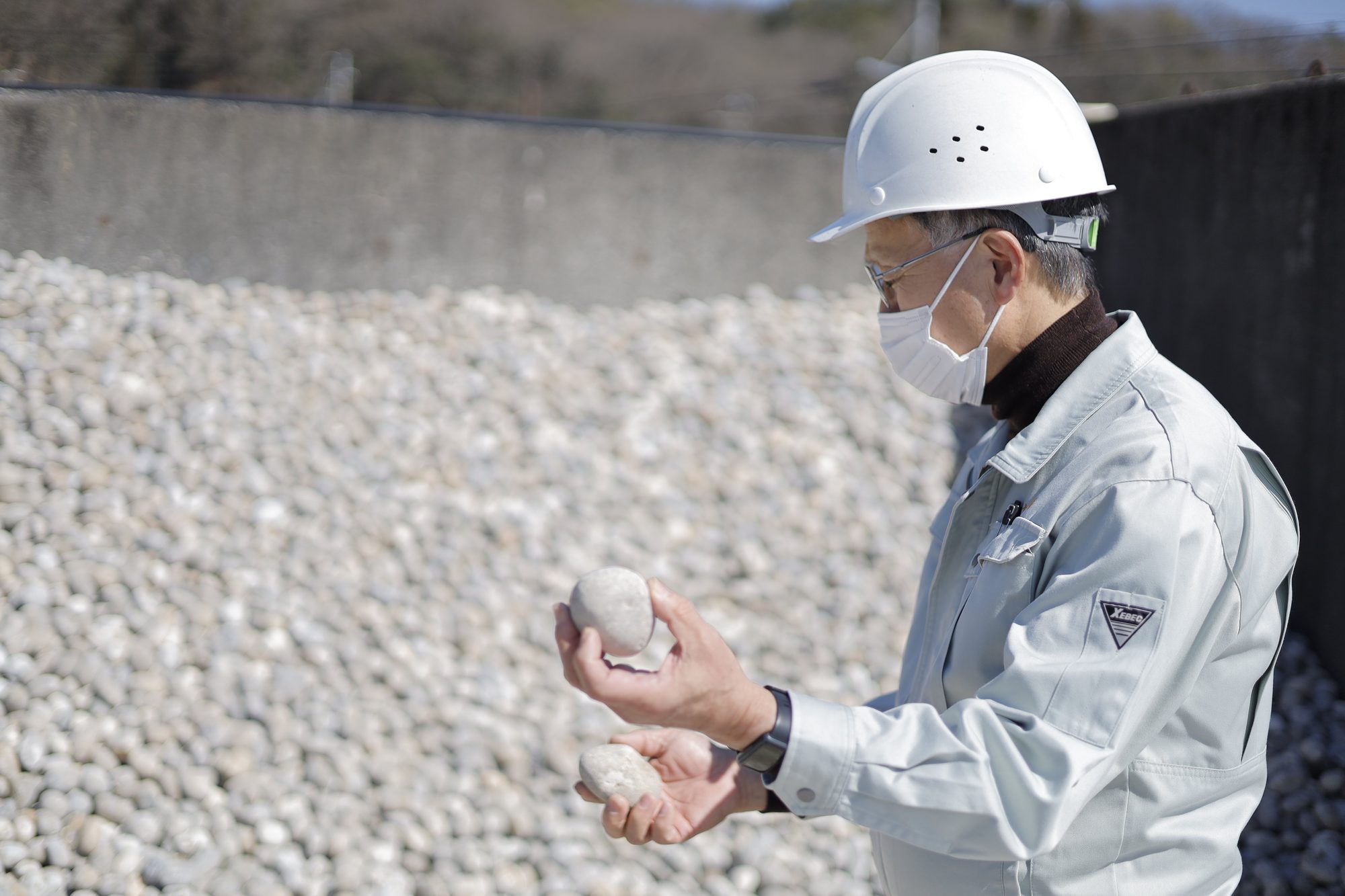
Clay — Yamaka Tory Co. (pioneer of white porcelain clay, since 1979). The three elements of "skeleton," "plasticity," and "vitrification" are kept under strict control, producing a fine porcelain clay that glows white and translucent under oxidation firing.
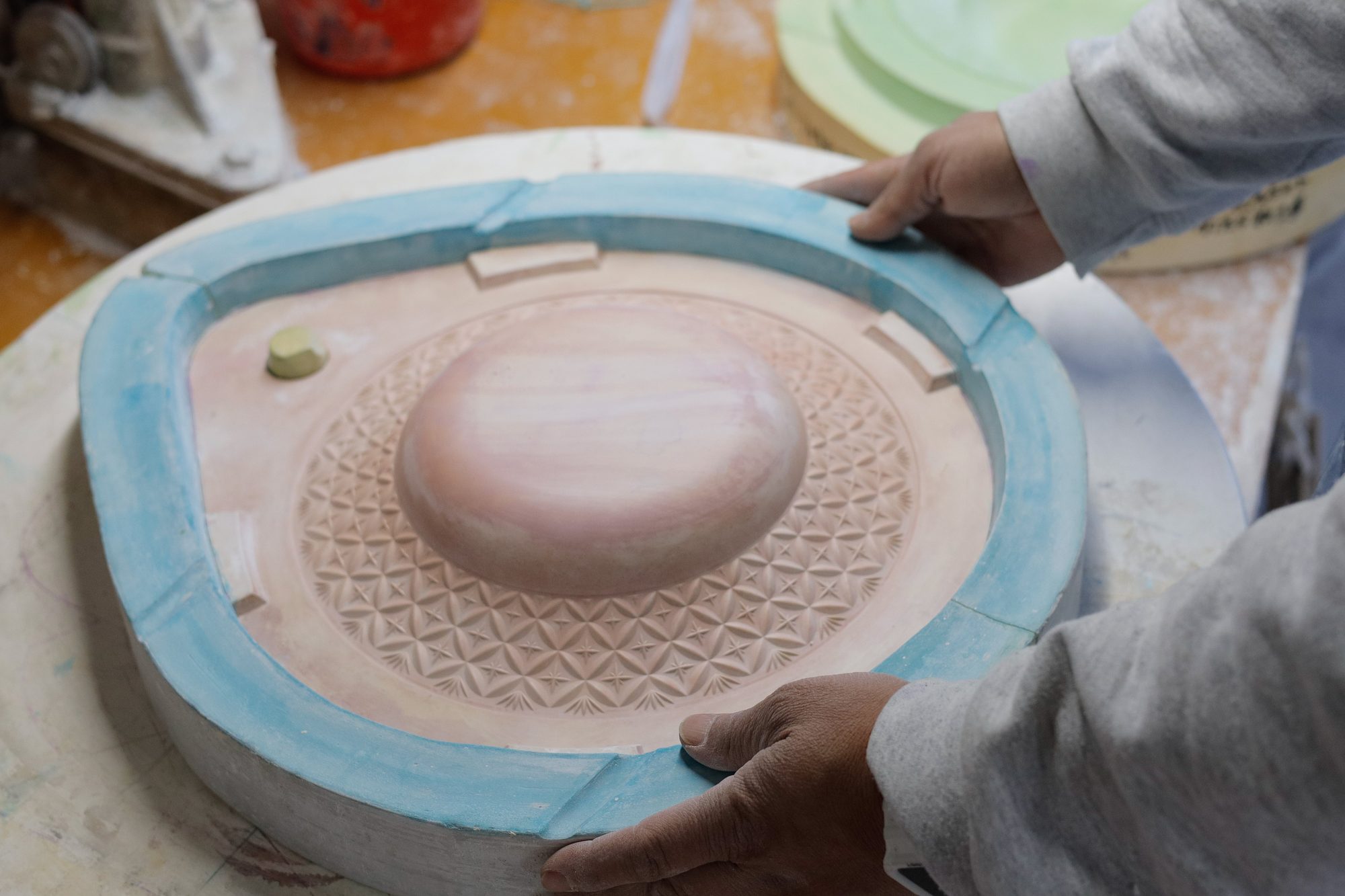
Mold — Kuroda Mold Workshop (founded 1978; second-generation head Yasuaki Kuroda). The mold-makers who support the ceramic industry from behind the scenes. They cut HINOMIYA's delicate kiriko molds and lay the foundation for production.
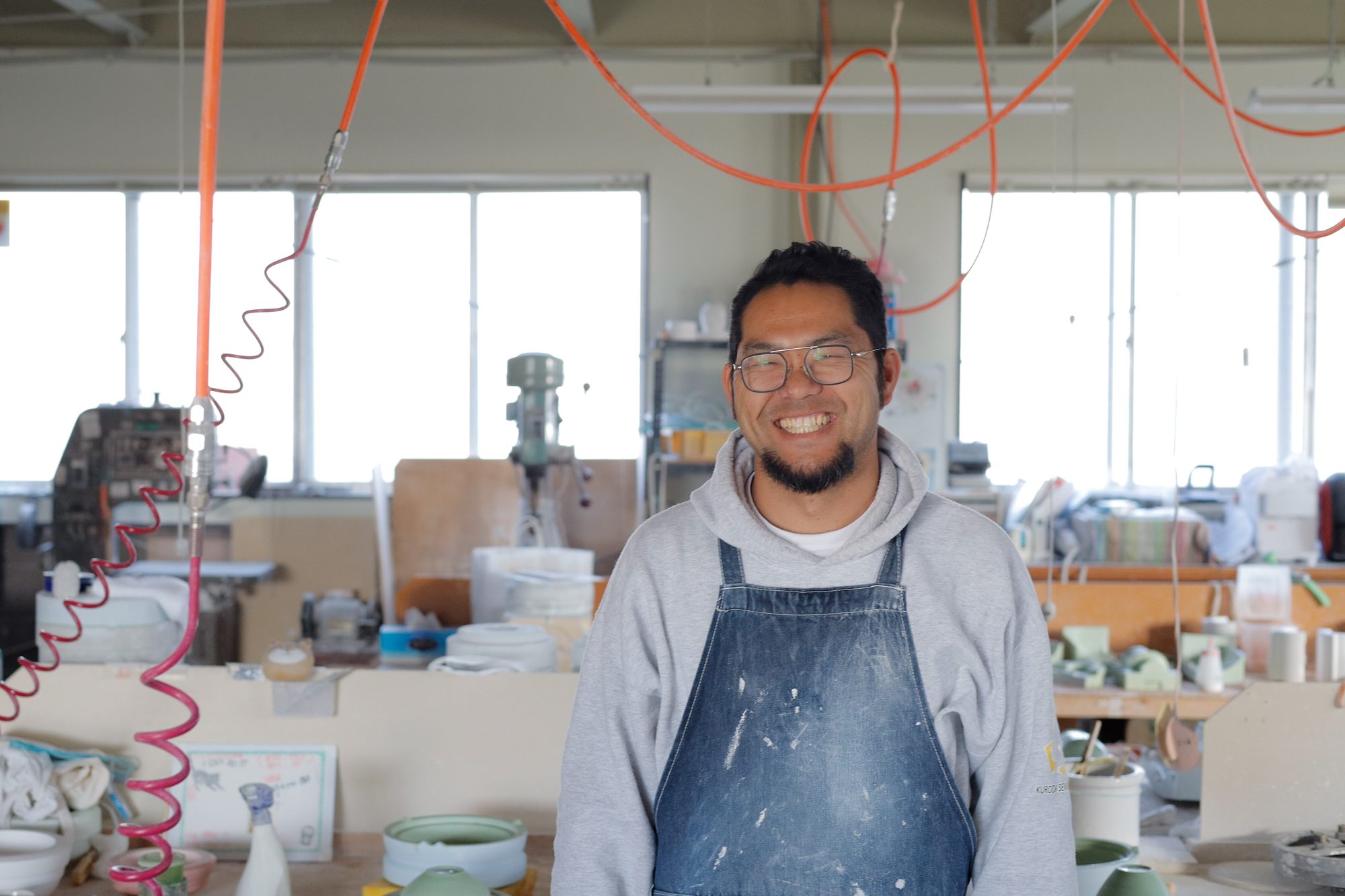
Casting — Mr. Mizuno, slip-caster. HINOMIYA's cups have such complex molds that, at present, only he can form them. Apart from the moment when the slip is poured into the plaster mold, almost everything is handwork.
Firing and polishing — Shota Miyashita fires the pieces in a custom kiln across multiple stages, then patiently polishes each one. The wall thickness needed to make solid porcelain transmit light, and the firing curve, are adjusted to within a single degree Celsius.
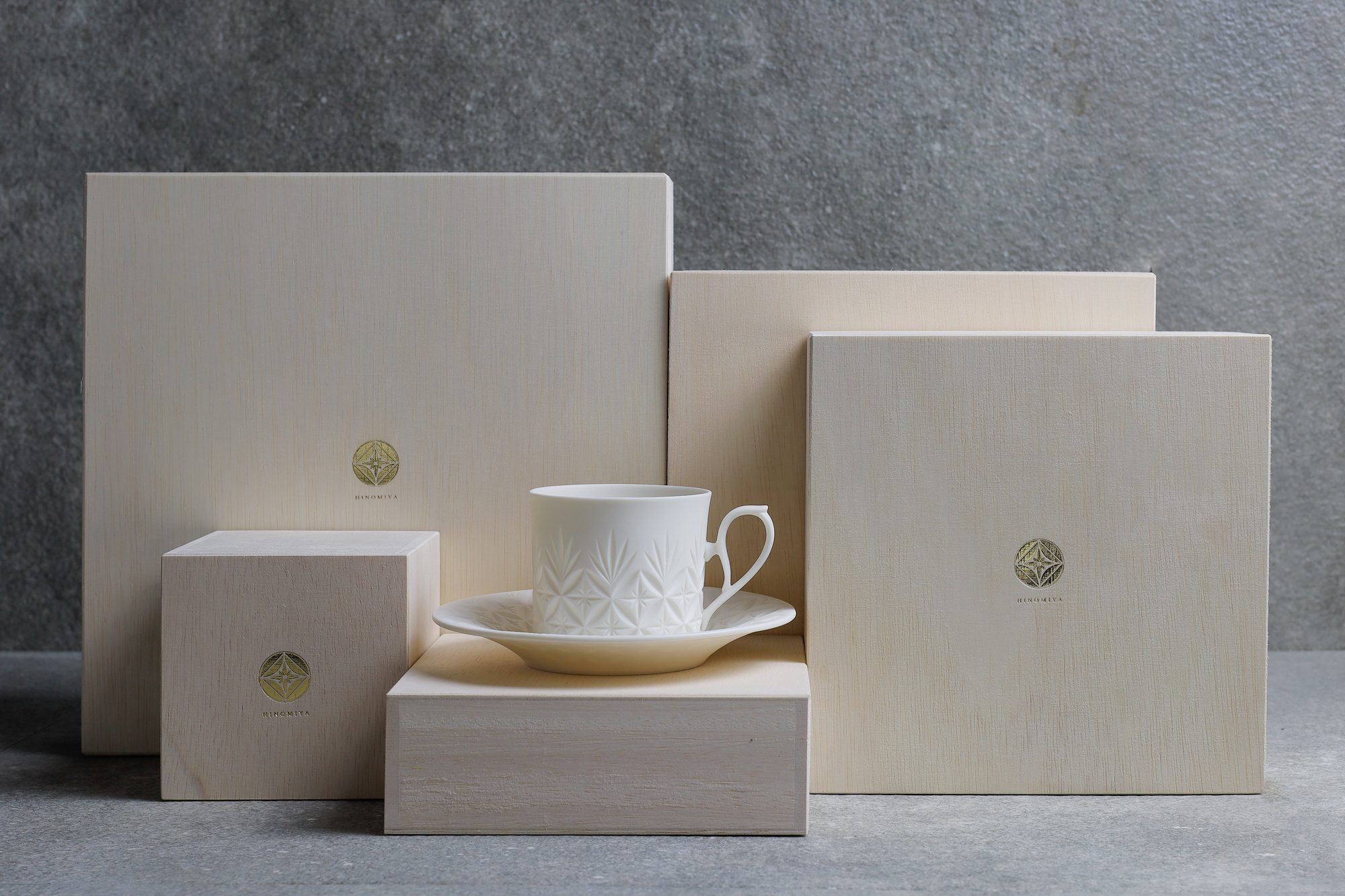
Packaging — wooden boxes are made one by one by hand at the traditional workshop Mihagi Crafts. The soft packaging uses fine washi paper in a "textured white."
I. Clay
Yamaka Tory Co.
ヤマカ陶料株式会社(1979〜)
A pioneer of white porcelain clay. By strictly controlling the three elements of "skeleton," "plasticity," and "vitrification," they continue to produce a fine porcelain clay that glows white and translucent under oxidation firing.
II. Mold
Kuroda Mold Workshop
黒田製型所(1978〜/2代目 黒田恭章)
Mold-makers who support the ceramic industry from behind the scenes. They cut HINOMIYA's delicate kiriko molds and lay the foundation for production.
III. Casting
Riki Mizuno
株式会社 一洋陶園 三代目 / 水野 力(1960年創業/1990年法人化)
The first generation worked in jiggering, making ashtrays and other goods; the second generation shifted to slip casting; and the third — Riki Mizuno — specializes in "forms that only slip casting can produce." HINOMIYA's intricate kiriko molds can, for now, be cast by no one else. Apart from the instant the slip is poured into the plaster mold, almost everything is completed by hand.
IV. Packaging
Mihagi Crafts
美萩工芸
The traditional craft workshop Mihagi makes each wooden box by hand. The soft packaging uses fine washi paper in a textured white.
§ III — Technique · Tk-03
Technique pressure casting × 3DCAD × translucent porcelain
Forming uses pressure casting, the production technique of mass-produced ceramics. Liquid porcelain clay (slip) is forced into a plaster mold under pressure, producing thin, uniform vessel walls with stability.
The relief is a kiriko-inspired motif designed by Hijiri Tougane in 3DCAD — a geometry difficult to reproduce by hand-carving, implemented here as a production-ready mold.
The material is the finest grade of Japanese porcelain clay. Fired pure and patiently polished, the carved rim becomes a structure that transmits light.
No compromise has been made for daily use: microwave, dishwasher, and oven (up to 150°C) safe. A vessel that holds refinement and function in the same hand — taking the best of both worlds.
§ IV — Iconography · Ic-α
Marks of meaning.
Traditional motifs and the meanings carried within these designs.
N° 01
Shippō-tsunagi (interlocking circles)
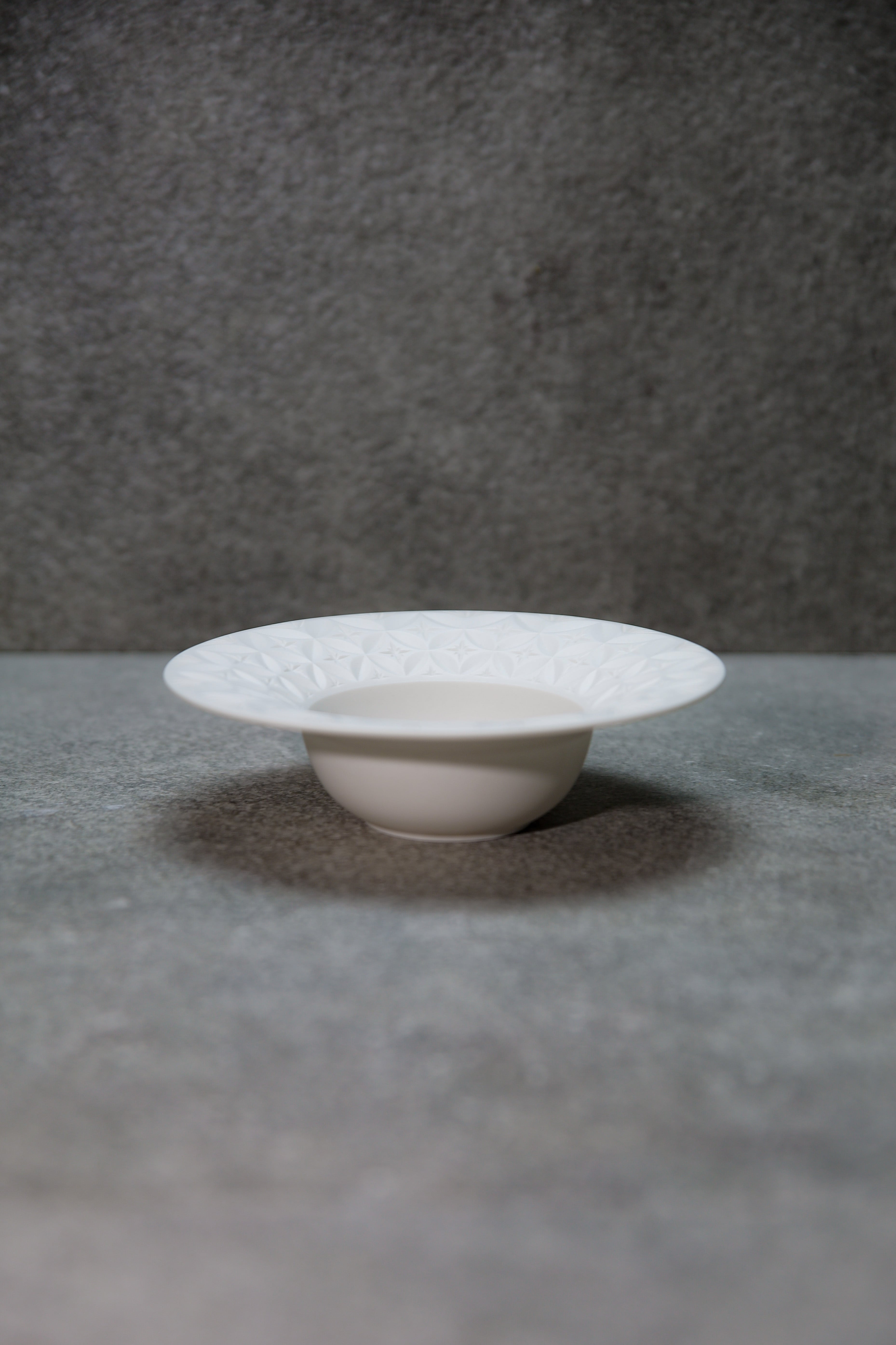
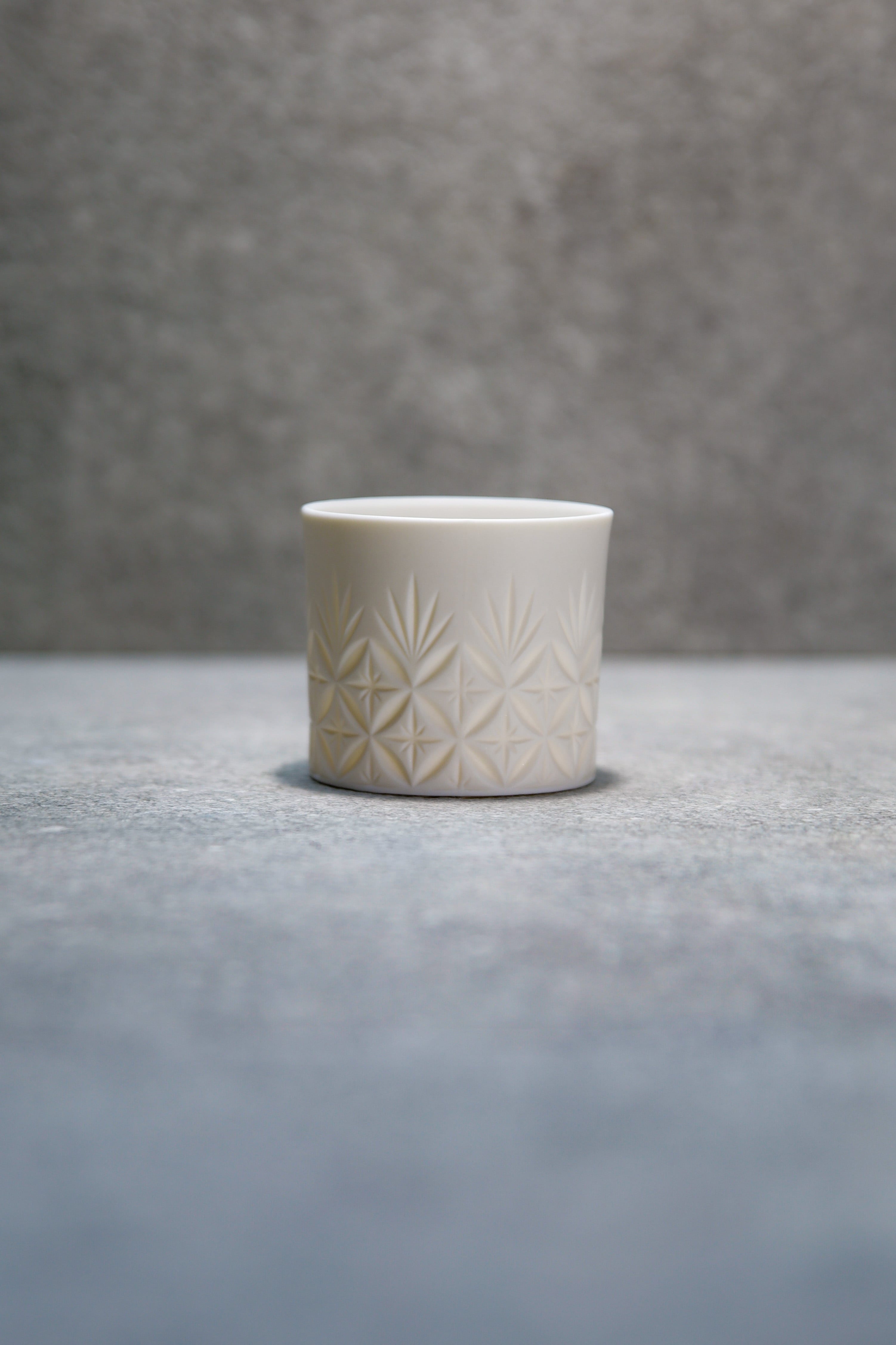
Shippō-tsunagi is an auspicious pattern in which circles overlap one another by a quarter, linking endlessly. The image of circles continuing forever has long carried wishes for prosperous descendants, lasting bonds, and harmonious relationships in Japanese tradition. HINOMIYA's relief brings this motif into three dimensions on translucent porcelain, so that the pattern surfaces through the play of reflected light.
§ Series — Idx-7
Series index.
A dictionary of series within HINOMIYA.
- N° 01
cup & saucer
カップ&ソーサー — cup ø80×H70mm / saucer ø160×H25mm — the drink shows through the wall.
- N° 02
free cup
フリーカップ — ø80×H70mm — tea or soup; the use is up to you.
- N° 03
mug cup
マグカップ — ø80×H70mm — with handle, sized for daily gestures.
- N° 04
saucer plate
ソーサープレート — ø160×H25mm — works on its own as a sweets plate.
- N° 05
flat plate
フラットプレート — rim ø220 / inner ø180 × H25mm — bread can be baked on it.
- N° 06
pasta plate
パスタプレート — rim ø260 / inner ø165 × H40mm — the kiriko rim frames the dish.
- N° 07
soup bowl
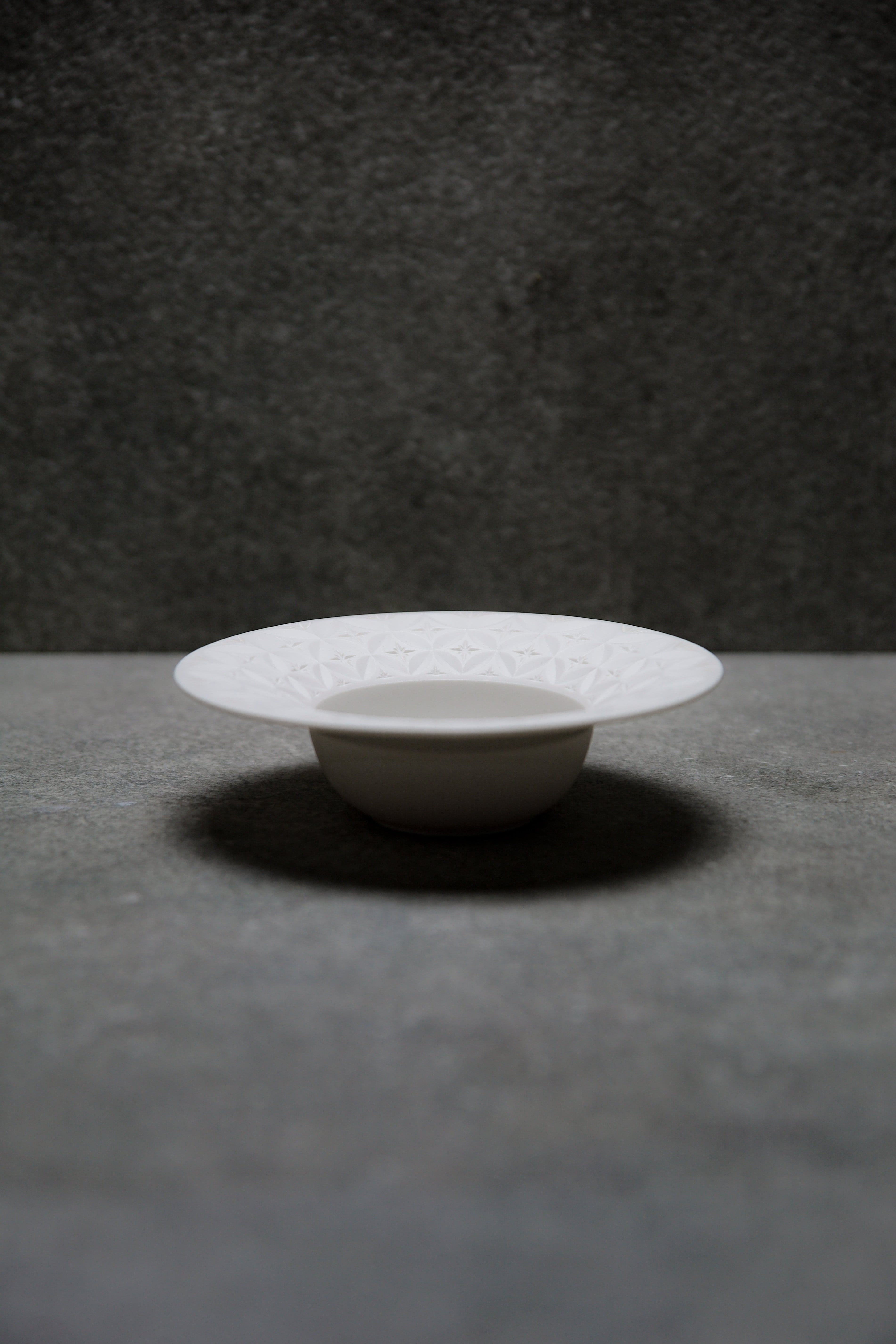
スープボウル — rim ø190 / inner ø90 × H50mm — a deep path for the spoon.
§ Products — Pr-7
From HINOMIYA.
7 pieces